


以下为英文原文。
A new business often needs a website before it has a full brand team, a large budget, or time to wait through a long design process. That is why the website builder versus web designer decision is rarely just about appearance. It affects launch speed, upfront cost, ongoing maintenance, who owns the work, and how easily the site can change as the business grows.
For many small businesses, the right choice is not the most customized option. It is the option that gives the business a credible site, clear operational control, and a manageable path for updates. The answer depends on what the website needs to do now and what you expect it to do next.
Website Builder Versus Web Designer: The Practical Difference
A website builder is a software platform that lets you create pages with templates, visual editors, and prebuilt features. You usually pay a monthly or annual subscription, choose a design, add your content, connect a domain, and publish. The platform manages much of the underlying technical setup.
A web designer is a professional who plans and creates a website for you. Their work may include brand direction, page layouts, content structure, custom graphics, user experience decisions, and coordination with a developer when custom functionality is needed. Some designers build on WordPress or another content management system. Others provide design files that a developer turns into a live site.
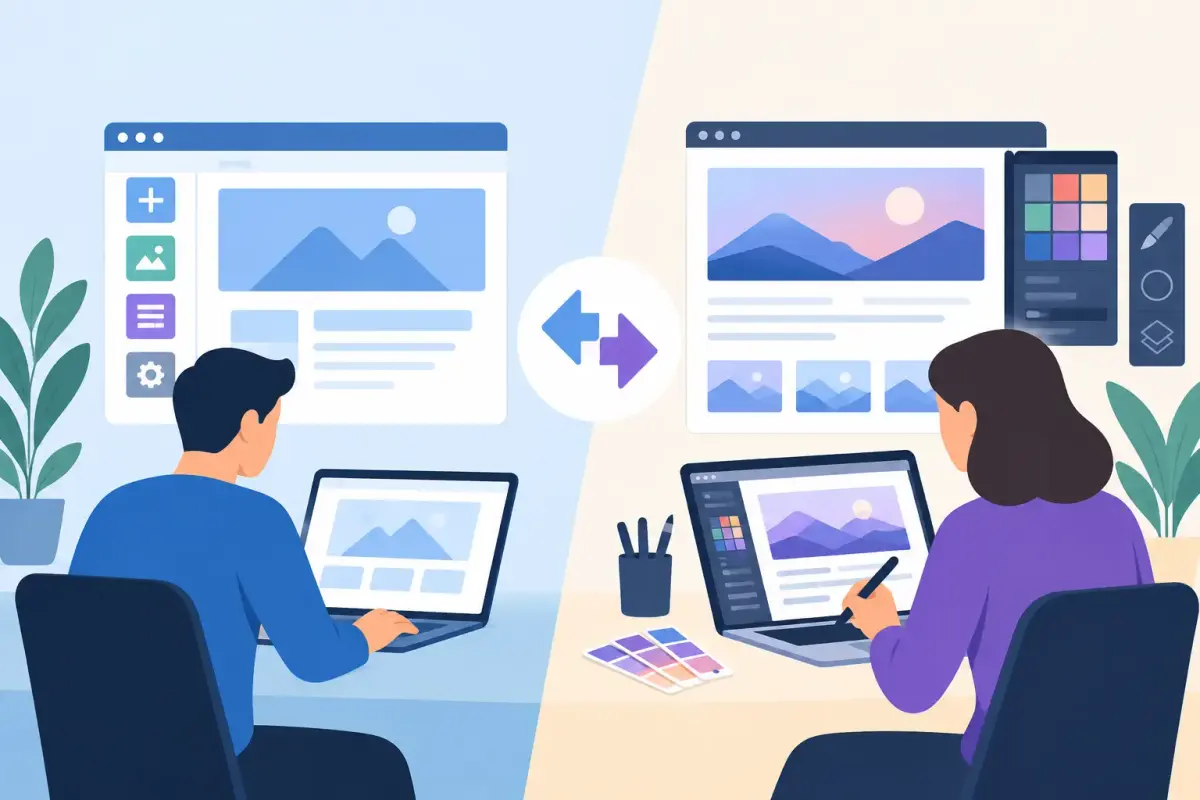
The difference is not simply DIY versus professional. A builder gives you a repeatable system with limits. A designer provides judgment and customization, but the result depends on the scope, the platform selected, and the people responsible for maintaining it after launch.
| Decision area | Website builder | Web designer | | --- | --- | --- | | Launch timeline | Often days, once content is ready | Often weeks or longer, depending on scope | | Upfront cost | Usually lower | Usually higher due to professional labor | | Design flexibility | Limited to the platform and template options | Can be tailored to the brand and business goals | | Day-to-day edits | Usually simple for non-technical users | Depends on the CMS and handoff process | | Custom functions | May be limited or require add-ons | Can be planned and built around specific needs | | Long-term ownership | Review platform export and account terms | Review contracts, licenses, access, and source files |
When a Website Builder Is the Better Business Choice
A website builder makes sense when speed and simplicity matter more than a fully custom design. A local service business with a clear offer may only need an attractive home page, services, contact details, testimonials, a location map, and a quote form. A consultant may need a professional online profile and a way to collect leads. In these cases, a well-organized template can be enough to establish credibility and start generating inquiries.
Builders are also practical when one person will handle routine updates. Changing business hours, publishing a promotion, replacing a photo, or adding a new service should not require opening a support ticket with a third party every time. If the platform is easy for your team to use, that independence has real value.
The trade-off is that templates can make businesses look similar, especially if the content and imagery are generic. Builders also have boundaries around layout, performance controls, integrations, and advanced content workflows. A feature that appears simple on a competitor's site, such as a custom pricing calculator, member portal, booking flow, or multi-location content system, may be difficult or costly to recreate within a closed builder platform.
Before choosing one, test the parts you will use every month. Check how pages are edited, how forms are managed, how SEO settings are handled, what happens to your domain if you change providers, and whether you can export your content. A low monthly price is useful only if the platform supports the work your business actually needs to do.
When Hiring a Web Designer Is Worth It
A web designer is often the better investment when the website must carry more of the sales process. That can include businesses with higher-value services, established brands that need a distinct look, companies with complex offerings, or agencies managing sites for clients with different requirements.
Good design is not decoration. It helps visitors understand what you offer, who it is for, why they should trust you, and what action to take next. A designer can organize a complicated service menu, create page hierarchy around customer questions, and make sure the site reflects the quality of the business. Those decisions are harder to get right by rearranging template blocks.
Custom work is especially useful when your site needs integrations, unique functionality, accessibility planning, tailored landing pages, or a content structure that will grow over time. A WordPress-based site, for example, can give a business more control over content and hosting than many all-in-one builders. It also introduces responsibilities for updates, backups, security, plugin selection, and performance management.
The risk is not hiring a designer. The risk is hiring one without a clear operating plan. Ask what platform will be used, what is included in the project, how revisions work, who supplies copy and images, and what happens after launch. Confirm that your business owns the domain, has administrator access to the website and hosting, and receives any required licenses or credentials. A beautiful site becomes an operational problem if only one outside person can update it.
Do Not Compare Only the Initial Price
A builder may cost less to start, while a designer may reduce expensive rework later. Neither option has one universal total cost. The useful comparison includes the time your team spends creating pages, gathering content, updating information, fixing problems, and coordinating vendors.
With a builder, recurring costs may include the plan, domain renewal, premium templates, email services, applications, transaction fees, and advanced marketing tools. With a designer, costs may include discovery, design, development, copywriting, photography, hosting, maintenance, and future change requests. Custom websites can also require more attention when software versions or integrations change.
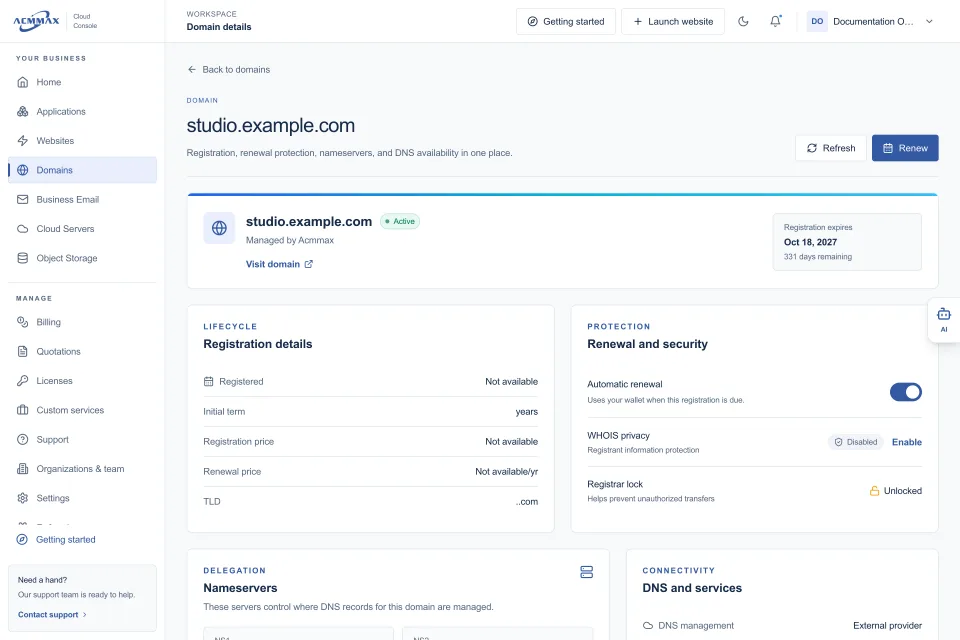
Treat the website as part of a larger operating stack. Your domain, DNS records, business email, hosting, backups, payment tools, and support contacts should not be scattered across accounts that nobody reviews. Centralized management reduces avoidable delays when a domain needs renewal, a mailbox needs access, or a site must be restored from a backup.
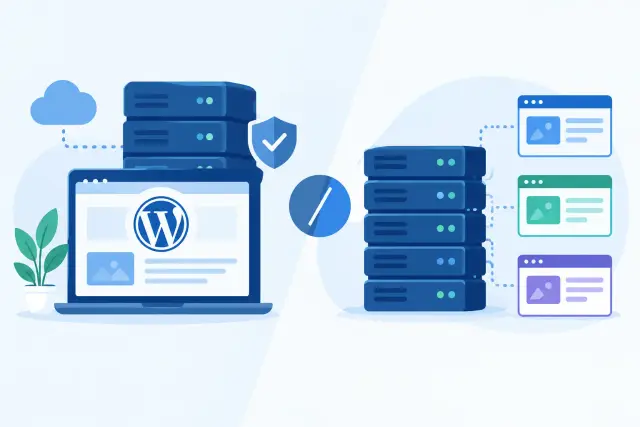
For WordPress sites, managed hosting can remove much of the routine server work while preserving the flexibility of a professional CMS. A platform such as ACMMAX can also keep website services, domains, email, billing, and support administration closer together, which is useful for businesses and agencies managing more than one service.
A Hybrid Approach Often Delivers the Best Value
You do not have to choose between a generic template and a fully custom project. Many businesses get strong results by using a flexible platform and bringing in a designer for the parts that matter most: brand direction, homepage structure, core service pages, and a reusable visual system.
This approach can shorten the launch timeline without leaving every design decision to a busy owner. It also gives the internal team a clearer framework for future updates. The key is to agree on what is custom and what remains template-based before work begins.
Another practical route is to launch a focused first version, then improve it after real customer feedback. Start with the pages needed to explain your offer and capture leads. Add resource sections, advanced automation, location pages, or specialized tools when there is a demonstrated business case. A site does not need every possible feature on day one, but it should not block sensible growth.
Choose Based on Your Next 12 Months
Choose a website builder if you need to publish quickly, your requirements are straightforward, and someone on your team can maintain the content. Choose a web designer if differentiation, complex content, conversion strategy, or custom functionality will materially affect revenue and customer trust.
If you are uncertain, write down the website's first-year jobs: generate leads, accept bookings, sell products, support customers, recruit staff, publish content, or provide client access. Then list the systems it must connect to and the people who will update it. That simple exercise usually makes the decision clearer than comparing templates or portfolios alone.
Your website should be easy to operate after launch, not just impressive on launch day. Start with the option that fits your current budget and team, keep ownership and account access clear, and leave room for the site to become more capable as the business earns the need for it.